A story about love, loss, faith, and the hope of connection that survives death.
Jasper is an old man now. His worn-out moccasins slide along the old, dusty wooden floor with careful, hesitant steps. Carlo can’t remember the last time he saw him. The last time he came to the campsite, he was a teenager. Back then, Jasper was strong and vigorous. The years have taken their toll. Carlo watches him as he shuffles around the office looking for the keys to the cabin. The cabin Carlo’s father owns. It hasn’t been used since Carlo’s father died.
‘You look just like your father,’ Jasper says as he pokes around the desk drawers. ‘Just like he did when he was your age. The resemblance is uncanny. Your father was a good man. I miss him.’
‘He always spoke very highly of you.’
‘That’s nice to know.’
Jasper finds the keys and hands them to Carlo. They are still attached to the same keychain, the one Carlo brought back from Spain.
‘I knew they were around here somewhere,’ Jasper says. ‘There’s no mistaking that keychain. It’s the only one like it around here.’
Carlo recalls his father’s expression when he first presented it to him. It was a Father’s Day gift meant for his house keys, but he used it for the cabin keys instead—his sanctuary.
‘You were just a boy the last time I saw you,’ Jasper says.
‘It’s been a long time.’
They look at one another in silence.
‘Anyway,’ Jasper says. ‘There you are. Everything should be in order. No one’s been there since your father died. He was a good man, your father.’
Jasper shuffles out the door, leading the way towards the cabin. It isn’t necessary. Carlo remembers the way. He doesn’t object and allows the old man to do his job.
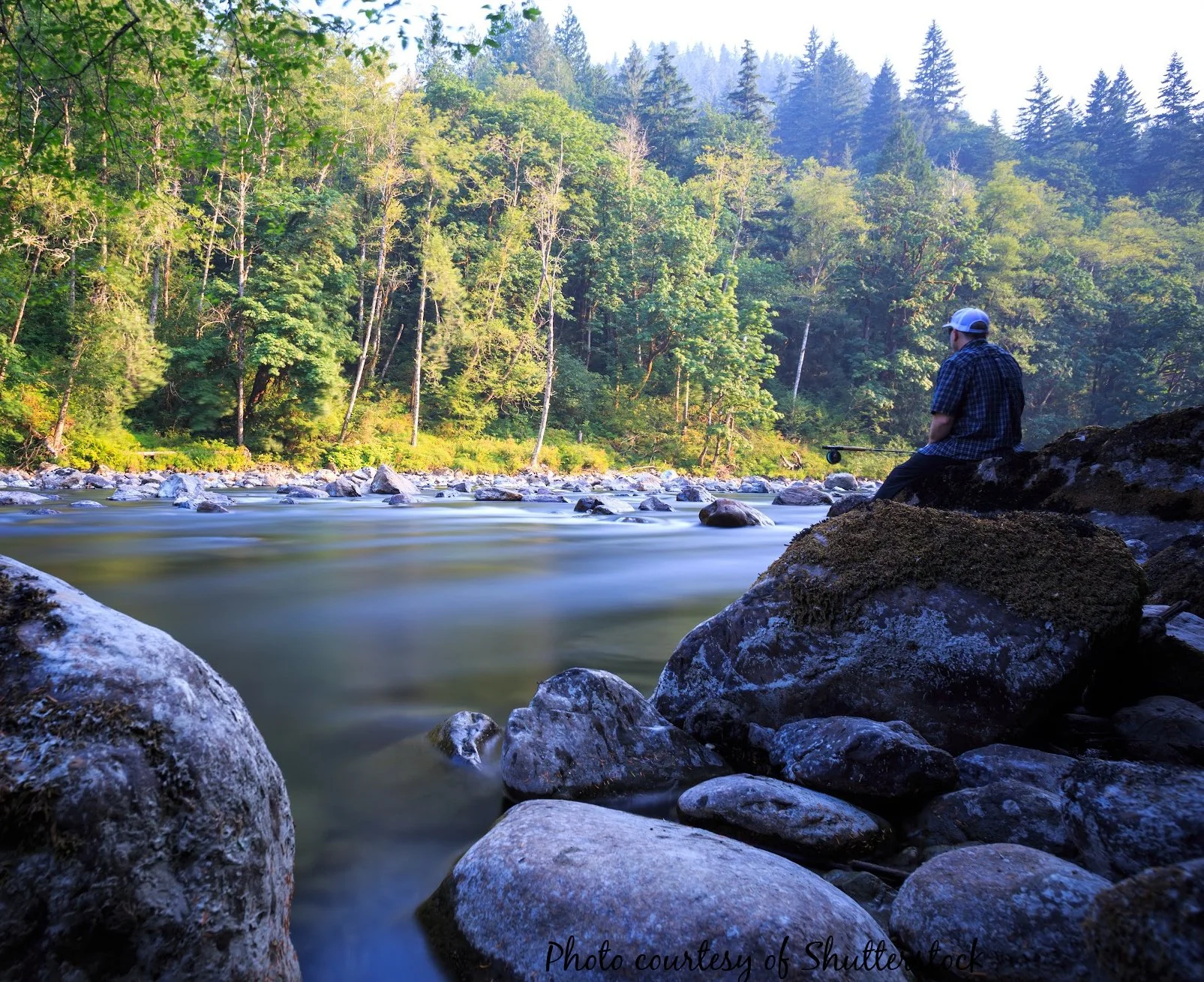
It’s a crisp November morning. The trees have turned color. The ground is damp from last night’s rain. It’s peaceful and silent, save for the old man’s moccasins shuffling along the dirt. Beside them flows the river, where Carlo’s father loved to fish. Carlo spent a lot of time beside the river. It’s nice to see it again.
‘So what brings you this way after all this time?’
‘Memories,’ Carlo says.
‘Of course. Your father was a good man. I miss him. I’m eighty years old now. Amazing. Your father was older.’
Carlo doesn’t say anything and follows the old man down the path. The sky is grey but light. There is no threat of rain.
‘Where are your belongings?’
‘In the car,’ Carlo says. ‘I parked it near the office.’
‘You should have told me; I would have helped you.’
‘I didn’t bring much.’
‘Well, all your father’s things are still in the cabin. You won’t need much, I suppose. What are you going to do? Some fishing?’
‘Maybe,’ Carlo says. ‘I mainly came to rest.’
‘There isn’t much to do other than that — and fishing.’
‘That’s fine. I could use the rest.’
The old man looks him over. ‘From what? You seem very rested and healthy to me. Much like your father was.’
‘It may not show.’
‘What do you do?’
‘I work in finance.’
‘Wall Street? Ah, yes, I remember your father saying something about that. He was very proud of you. Your father was a good man. I miss him.’
They approach the cabin. It looks well maintained. Dead leaves have collected in front of the door. Jasper sweeps them away with his foot and steps aside to allow Carlo to unlock the door. Carlo steps inside while Jasper waits in the doorway. The air is damp and musty and smells of old wood.
It looks the same. All his father’s belongings are still where he left them. His fishing rods stand next to the fireplace, and his Bible sits on the table.
‘The flowers that were in the vase were all dried up, so I threw them away,’ Jasper says.
‘That’s fine. You’ve done a wonderful job maintaining it.’
‘That’s my job. Besides, I always liked your father. It was the least I could do. Sometimes I’d like to think he'd come back at some point, so I wanted to keep things tidy. He was a good man, your father. I miss him.’
Everything is as it was, as if he'd been there yesterday. The bed is covered with the same bedspread, the same keepsakes sit in the same places on the mantelpiece, the same generic landscape painting hangs on the wall above the fireplace, the same coffee table, the same chairs, the same bookcase with all this father’s books.
‘Thank you,’ he says to Jasper.
‘Do you need any help with your things?’
‘No, thank you. I’ll take care of it.’
‘Well, if you need anything…’
Jasper closes the door. It’s very quiet. The kind of silence he seeks. He goes through the cupboards to see if there is anything, but they’re all empty, save for a few candles and a box of matches. He’ll have to do some food shopping. There’s fishing, of course, which is how his father usually fed himself, but he’s not his father and has become a creature of convenience. He inspects the refrigerator. It’s in good working order but empty. He then tries the stove. An electric one. It works well, but he sees no reason why it wouldn’t. He's amused that the modern age has worked its way into the old cabin. When his father bought it, it was rustic, minimal, as were all the cabins on the site. Times have changed. No one wants to live like that anymore. Had it not been for his mother, who loved coming to the cabin, his father would have left it as he found it.
He removes his cellphone from his pocket to find the nearest grocery store. He’s not getting a signal. Just as well, he thought. He remembers seeing a grocery store a few miles back.
. . . . . .
Carlo sits on the riverbank and smokes one of his father’s cigars. He found a few in the humidor stashed away in the bookcase. It’s a bit stale but still smokeable, and the smell of it reminds him of how his father used to smell. It’s quiet, and he listens to the crackle of the small campfire. It’s not a clear night. The air is cool and smells of wet dirt. The sky is still overcast, hiding the stars; however, his memory of the starlit sky above him is ever present. It’s a sky he’d seen many times. Before him, the river flows, and he momentarily considers breaking out one of his father’s fishing rods in the morning and trying his hand. He wasn’t much of a fisherman, even as a child. His father's Bible sits beside him on the damp ground. A rather unassuming one, but one handed down through many generations. He’s not even sure why he has it with him. To have his father near, perhaps. He picks up the Bible and leafs through it. Its pages are thin and worn. His father had highlighted certain passages, but it’s hard to read them in the campfire light. He places the Bible down beside him again.
Sounds fill the air now: the crack of branches, the rustle of dry leaves, and other vocalizations from animals he can’t identify. He checks his cellphone for messages but still can’t get a signal. Just as well, he thought. Silence is what he desires. He closes his eyes and listens to the campfire crackle. He tries not to think of anything but the sound of the fire, but other thoughts creep in: his work, his wife, his two children, his debts, his mortgage. He opens his eyes and looks at the campfire. The flames have grown lower. He tosses some dry twigs into the fire, then the remainder of his father’s cigar. How is it done, he wonders? He looks towards the river. It’s barely visible in the dark, but he can see a glimpse of it in the glow of the moonlight behind the clouds. Jasper, who lives in the town near the campsite, was always a strange man with strange ideas. Jasper would often talk to his father as he fished in the river. Jasper said the river had moods; sometimes it wanted to give, and other times it wanted to take. His father would listen and show him proper respect, but later joke about it. Carlo never knew what Jasper was on about, or why his father found it so amusing. Now he thinks he understands. Perhaps there wasn’t anything funny about it at all.
He lies down on the ground and looks up at the sky. A small patch of clear sky reveals itself. The warmth of the fire feels good. It reminds him of childhood and the weekend camping trips with his father. Memories. That’s all he has. Not connection. He doesn’t feel him. Absence. A name, a memory, a cigar, and a bible. Nothing more.
. . . . . .
The morning is heavy with fog. It lies over the river and drifts into the trees. The air is damp and cold, colder than it was the previous morning. He had prepared a pot of coffee on the stove. He takes one of his father’s fishing rods and some tackle with him. He returns to the same spot and sets up a small campfire. He places the pot of coffee over the flame. He lays the fishing rod and tackle box beside him and sips his coffee. From his shirt pocket, he removes another of his father’s cigars and lights it over the fire. He eyes the fishing rod. It had been a long time since he’d done any fishing. He isn’t even sure what to do. He’ll wait until the fog lifts. He sits quietly, sipping his coffee and smoking his father’s cigar, blowing plumes of smoke into the fog. The smoke swirls within it, drawing interesting patterns in the mist. His father used to do that on misty, foggy days such as this. He shuts his eyes and becomes still, trying to connect. He listens to the chirping of the birds, the acorns hitting the ground, the rustle of leaves in the breeze, the movement of squirrels among the dried branches and dead leaves, but he senses nothing. He opens his eyes and watches the fog over the river and over the trees on the opposite bank, his cloud of cigar smoke drifting in the mist. He listens closely for the sound of the river. It’s ‘song’ as Jasper once spoke of it. He’s not sure why he still remembers that.
He places the cigar in his mouth and reaches for the fishing rod and tackle box. He pokes through the tackle box looking for what he thinks he needs, but he doesn’t know what he’s looking for. It’s been too long. He does his best to prepare the rod and walks to the riverbank. He could use his father now to remind him what to do. He casts the line into the water and waits. If he catches anything, it will be a miracle. I need you now, Dad, he says to himself. The fog remains. The line disappears into it. He can feel the weight of the lure in the water.
Is this how it’s done? He no longer remembers. He is not his father. He should have paid him more attention. He knows he has no idea what he’s doing, but it’s the act that matters, even if it’s nothing more than a performance. It helps him to connect, and perhaps this is one way to do so. He can’t help sensing his father out there, laughing at him, poking fun at him, along with all his other deceased relatives, refusing to intervene, amusing themselves. His father always did well whenever he fished in this particular river. As a boy, he always thought it was sheer luck to catch anything. He hardly ever did, but that never mattered. It mattered not to his father, either. It was the act, the ritual, the bonding. As he grew older, he never believed much in luck. To him, luck was just a word for when things happened the way you wanted them to. The universe doesn’t care. It’s cold and indifferent. It is the height of conceit to believe anything else. Why would something so vast care about his petty concerns? Does it care about all living things? Will it care about that poor fish if he happens to hook one?
His father, on the other hand, was religious. He read his Bible every morning. He had one at home, one at his workplace, and one in the cabin. He never discussed his religious views with his father. He let him believe what he thought. He played along with all the rituals and sacraments, but, like his attempt to fish, it was all pantomime. His father would have never understood his way of thinking. Yet, in some way, some of it stuck. He wouldn’t be there right now had it not.
He sits there a long time, waiting for a bite. Nothing does. He reels in the line, returns to his spot next to the campfire, and pours himself another cup of coffee. He’s still, lost in thought. Everything is quiet. Then he thinks about the city, about the noise, the crowds, and the confusion. It’s no wonder his father loved to come up here. It was more than an escape. It was spiritual, though his father would have never described it that way. His father felt a lot of things but never said them.
The fog begins to lift. The sun attempts to break through the clouds. He watches the river and its endless flow. He meditates on that for a little while, watching the current carry broken branches and dead leaves towards its unknown destination. It’s a view he remembers from childhood, when his father first took him to the campsite and he watched him try to bag another trout. Where did it all go, he wondered then? He wonders the same thing now.
The sound of someone approaching diverts his attention. Shuffling down the path, dressed in a faded red-and-white flannel shirt, faded grey cotton pants, and a Vietnam veterans baseball cap, Jasper makes his way toward him.
‘I went to the cabin to see how you were doing,’ Jasper says when he reaches him. ‘I had a feeling I’d find you here. This was your father’s favorite spot.’ He removes his baseball cap, wipes sweat from his forehead with the back of his hand, and looks out over the river. ‘Water’s high,’ he says, putting his cap back on.
‘Looks the same to me.’
‘You have to watch it. It ebbs and flows. No need to worry about flooding, though. It could rise to this level if it rains enough.’ He eyes the fishing rod. ‘Catch anything?’
‘I’m afraid not.’
‘You doing okay?’
‘Yes, fine. Why were you looking for me? Is there a problem?’
‘No, no problem. Just looking in on you.’ He removes his cap, wipes his forehead again, and looks out over the river. The fog is still there but slowly lifting. ‘I used to look after your father,’ he continues. ‘Sometimes I think I used to annoy him, but he was always good to me. Especially after I came back from the war.’ He points to his cap. ‘You were probably just a boy when I was in the war. Your father, he wasn’t in the war. He was a bit older than me. He missed it, thank God.’
‘Would you like a cup of coffee? There’s some left in the pot.’
Carlo pours him a cup and hands it to him. ‘I don’t have a chair,’ he says, ‘but you’re welcome to join me.’
Jasper doesn’t say anything and sits down beside him, though not without a bit of a struggle. He sips the coffee and looks out at the river. ‘Yep, it ebbs and flows,’ he says. ‘It doesn’t matter if you believe it, but it does.’
‘I’ve no reason to doubt you.’
Jasper sips his coffee, then eyes the fishing rod. A faint smirk tugs at his lips. ‘So no luck, huh?’
Carlo looks at the fishing rod. ‘I was never much of a fisherman. I don’t really know what I’m doing.’
Jasper eyes the fishing rod again and smiles, sipping his coffee. ‘Everything comfortable in the cabin?’
‘No complaints. It’s quiet.’
‘Yes, it’s very quiet here.’
‘It’s what I wanted, though.’
‘Your father, too.’ He looks Carlo over. ‘I can’t get over the resemblance.’
They both sit in silence, staring out over the river. Then Jasper looks up at the sky.
‘Another storm is coming,’ he says.
Carlo looks up. ‘It looks like it’s clearing to me.’
‘No, it’s coming. Don’t you feel it?’
‘It feels just a bit chilly.’
‘Trust me. You live out here long enough, you can tell.’ He sips his coffee. ‘Your father, he could tell. He wasn’t always a good listener, though. Sometimes I thought he laughed at me.’
‘Why do you say that?’
‘Just a feeling.’
‘Well, Dad was sort of traditional.’
‘That he was. I don’t think he always understood what I said to him. Different generations, I suppose. But I think he intuitively understood. That’s why he loved coming here. Spend enough time here, you begin to understand.’
Carlo doesn’t say anything.
‘You don’t get me, either, do you?’ He sips his coffee. ‘That’s okay. Not everyone does. Take this river, for instance. It flows, and it will continue flowing, whether we are here to see it or not.’
‘I remember when I was a kid, you said something about the river having a song.’
He looks at Carlo. ‘You heard me say that?’
‘I do. I think I was eight or nine. My father was fishing right on the bank over there. You were with him, drinking a can of beer. You said that to him.’
“Well, I’ll be darned,’ Jasper says. ‘And you remember that?’
‘I never knew what you meant, but I thought about it often over the years.’
‘Your father just laughed. I didn’t take offense. He didn’t understand.’ He drinks the remainder of his coffee. ‘Your father read the Bible often enough, but he never seemed much into reading anything else.’
‘That’s true. Most of the books he has in the cabin are about fishing.’
‘Yeah, he knew a lot about fishing.’
‘So what did you mean?’
‘You have to experience it,’ he says. ‘You have to really listen. I learned that in the war. There was a river, not too different from this one. I learned it there. I kept it to myself, though. No one would understand.’
‘My dad mentioned you were in the war.’
‘It’s not exactly my fondest memory. I don’t like to talk about it much.’
‘I understand.’
Jasper stares out over the river. The fog has receded into the trees. ‘You come to learn a lot of things experiencing something like that. Heck, I was just a boy. I’m grateful that I survived. But I learned a lot about what’s important and what isn’t. Your father, he sometimes went through things. I tried to help him. He was a good man, your father. I miss him. I met him before I went to war. I worked here on the site when he used to come up to fish. I was probably seventeen, eighteen years old. Maybe just before you were born. He was always kind to me. I appreciated that.’
‘He lived a long, fruitful life.’
‘Still, you’re never quite prepared to lose them. Even when they get old.’
Jasper looks up at the sky again, points to the gathering clouds in the distance, over the tree line. ‘See?’ he says. ‘I told you another storm is coming.’ He tries to stand up. Carlo helps him to his feet. ‘I ought to get going,’ he says. ‘There are things to do.’ He looks up at the sky again. ‘You still have a little time. It won’t rain for another hour or so. Thank you for talking to me.’
He begins shuffling away, back toward the office. He stops, turns around, and asks. ‘Are you a religious man?’
‘I was raised a Catholic.’
Jasper laughs. ‘A very interesting choice of words,’ he says, grinning. ‘You wouldn’t happen to be a lawyer by any chance. No, no, you’re not. Wall Street, right? Your father was very proud of that.’
Carlo sits down on the ground, a little closer to the campfire, and tosses a couple of dried twigs into the flame. He relights the cigar off the flame, looks out over the river. He sits silently for a moment and listens. He doesn’t hear anything.
. . . . . .
The rain on the roof of the cabin is steady and hard. Carlo lies on the bed and listens to its hypnotic rhythm. Nature’s percussionist. His father’s Bible lies open next to him on the bed. He was curious about the passages his father chose to highlight. The ones he did seemed out of character. Interestingly, none of the highlighted passages were from the Old Testament. The majority of them were sayings attributed to Jesus. He read until his eyes grew heavy, then set the Bible aside to listen to the rain. Jasper was right, and he now wonders what else the old man may have been right about. He closes his eyes and listens, trying to connect. All his father’s things surround him, yet his father seems curiously absent. He asks for a sign, for anything which might answer his questions. He eyes the Bible next to him and considers continuing to read it but instead closes it. He lays it on the night table next to the bed. It seems strange sitting there, so he gets out of bed and places it on the table where his father originally left it.
The rain intensifies. The wind whips the branches into a frenzy, scattering dead leaves and broken branches all around the cabin. Puddles form in the dirt. He looks out into the trees, up at the sky, but he can’t see anything beyond the perimeter of the cabin’s outdoor light. It rained like this once, when he was five, during a summer excursion to the cabin. The thunder and lightning terrified him. He crouched beside the bed as the wind shook the cabin's walls and made the lights flicker. His father’s presence eased his fears, and he was coaxed out from behind the bed to look out at the storm through the same window. He was no longer afraid, and he faced it with all the courage he could muster. He didn’t want to disappoint his father, who stood by him, his big hand resting on his shoulder, a cigar burning between his lips. His mother wasn’t there that time. It was just the two of them, a long weekend of hiking and fishing. But he’s no longer there, the storm isn't as severe, and even if it were, he’d overcome his childhood fear of storms. There were other storms to worry about now, ones that were not as easily overcome. He thought of Jasper then, wondering if he was still at the campsite or had left before the storm he knew was coming arrived.
The power goes out.
He lets his eyes adjust to the dark, then slowly moves toward the bed. He gropes for his cellphone on the night table. He shakes it and turns on the flashlight. He remembers the candles and the box of matches in the cupboard. He lights three of them — one for the table, one for the kitchen counter, the other for the night table. He leaves the cellphone flashlight on, propping it up on the mantle. He sits on the foot of the bed and listens to the rain. He glances at the sheet of rain running down the window. Other than the wind and the rain tap-dancing on the roof, it is eerily quiet. He lights one of his father’s cigars and paces the room, staying within the perimeter of light the candles and cellphone flashlight offer, taking the same steps over and over again, like a monk in a labyrinth. He eyes his father’s Bible on the table, but he does not reach for it. It sits there, under the flickering candlelight. His father found solace in those pages. He never could, though he had tried. Even tonight, as he read his father’s highlighted passages before the lights went out, he tried to reconcile the man his father was with what he read. What did he seek, and why?
A knock sounds at the door.
Jasper stands before him in a yellow rain slicker and matching bucket hat pulled down over his eyes. He’s holding a red plastic lantern. Behind him, the storm rages on.
‘The whole site lost power,’ Jasper says. ‘Are you doing all right?’
He steps aside to allow Jasper in. Jasper looks around the cabin, says, ‘You found the candles. Your father was always prepared. Do you need anything? I’m making the rounds to see if anyone needs anything, not that there are many people here.’
‘I’m okay, thank you. I just wasn’t expecting it.’
‘It’s a local problem. The wind knocked down a tree into some power lines. It’ll probably be out all night.’ He looks around the cabin again. ‘Does your father have a lantern?’
‘I didn’t see one.’
Jasper looks under the sink. ‘Ah,’ he says, and reaches towards the back. ‘Here you go,’ he says, and looks for the switch. He flicks the switch, but nothing happens. ‘The batteries must be dead. Does he have batteries around? No matter. I have some in the office.’
Jasper places the lantern on the table.
‘You were right about the storm.’
‘You get to know after a while.’ He looks out the window. ‘It’s like a nor’easter, but none was forecast. Strange. It’s really coming down.’ He turns away from the window and looks around the cabin again. ‘I just need to make a couple of stops, check on the other guests, and I’ll be back with the batteries.’
‘No worries,’ Carlo says. ‘I was just about to go to bed, anyway.’
‘Do you want them?’
‘Don’t trouble yourself. The candles should do just fine.’
Jasper shrugs and starts for the door.
‘Have you been here the whole time?’
‘I’ve been in the office. I sometimes stay here. Thank God I did because I’m sure the roads are a mess. Would have had a heck of a time getting back here from town. And now with the power out and all…’
Carlo opens the door for him. The storm still rages, the trees bending and swaying in the wind.
‘Sometimes when it rains like this, it makes you think,’ Jasper says, looking up at the sky. ‘Sometimes nature has its way of throwing a tantrum. Could be one of those times. It’s because of how the world is these days. No one wants to listen anymore.’
Without another word, Jasper points his lantern ahead of him and steps out into the rain. Carlo watches him until he disappears into the night. He closes the door and laughs, though he isn’t sure why. It probably would have amused his father, too, he muses.
He eyes the Bible on the table. He walks over to it and opens it at random. In the candlelight, he reads one of his father’s highlighted passages: Whoever believes in me, as the Scripture has said, out of his heart will flow rivers of living water.
He sits on the foot of the bed, closes his eyes, and tries again to connect. Nothing. He lies back on the bed and listens to the wind and the rain drumming on the roof of the cabin.
. . . . . .
The bank where he had been sitting is gone. The river had risen. Broken branches and leaves spin in the current. He stands a few feet from the new shoreline, his father’s fishing rod lying against his shoulder. It’s almost an entirely different landscape. The air smells of wet earth.
‘See?’ a voice calls from behind him.
He turns to see Jasper walking towards him, his rain boots sinking into the mud.
‘That was one heck of a storm,’ Jasper says. ‘I hear the power will be back up later this morning. Everything okay?’
‘I thought I’d get some fishing in.’
‘The river rose. That was one heck of a lot of rain.’
They both survey the debris the storm left in its wake.
‘It happens sometimes,’ Jasper says. ‘It’s beautiful in its own way. It’ll recede though. It always does.’
‘How are the roads?’
‘Why, are you leaving?’
‘Just curious.’
‘A bit of flooding. Some trees down. Not impassable but treacherous.’
‘I guess fishing is not in the cards this morning.’
‘Did everything hold up all right? Another cabin, a little ways down from here, water came through the roof. I have to go over and take a look at it.’
‘No issues at all, no. Just no power.’
‘Your father, he was looking out for you.’
‘I’d like to believe that.’
‘You don’t think so?’
‘I don’t feel him.’
‘Maybe you’re looking in the wrong place.’ Jasper surveys the area. ‘That was quite a storm. Mother Nature sure threw a tantrum last night.’ He looks up and down the river. ‘It just keeps flowing. It doesn’t care about us, does it? It does what it wants. Anyway, if you need anything, you know where to find me. I have to look at that other cabin. Hopefully the damage is not too bad.’
Jasper walks away, carefully navigating the wet earth.
Daylight continues to rise beyond the tree line. The current carries debris downstream. He lights one of his father’s cigars and watches Jasper still trying to make his way towards the damaged cabin. He wishes he could be more like the old man and take things in stride the way he seems to. He isn’t built that way. He thinks too much. He thinks about things people say to make themselves feel better. He thinks of the river and how the river doesn’t care. He keeps listening for its song. Perhaps one day he’ll hear it.
Julian Gallo is the author of Existential Labyrinths, Last Tondero in Paris, The Penguin and The Bird, and other novels. His short fiction has appeared in numerous magazines around the world. Julian can be found at juliangallo.substack.com and https://www.facebook.com/julian.gallo/.